NotesWater Guns
The five types of toy water gun, and what separates them
Pocket squirt, streamer, pump-action, backpack tank and electric are five different products, not five words for one. What actually separates them on the floor, on the shelf and in a toy safety file.
Ishaan Mehra · 6 September 2026 · 6 min read
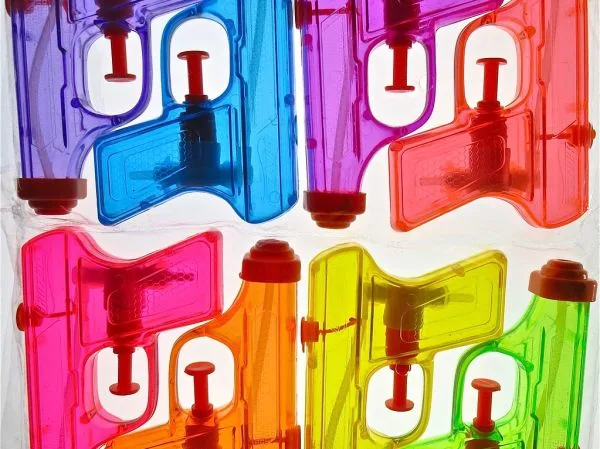
A buyer wrote to us in June asking for "water guns, one forty-foot container, best price." It is the most common way this conversation starts and the least useful one, because there is no such thing as a water gun in the way there is such a thing as a tennis ball.
There are five of them. They share a name and very little else — not the mechanism, not the moulding, not the shelf they sit on, not the margin they carry. A price for one tells you nothing about the price of another.
Sorting this out costs ten minutes on a first call and saves about a month, because the class decides the tooling and the tooling decides everything downstream of it. So here is the category as we actually build it at Faridabad, and what genuinely separates one from the next.
The pocket squirt
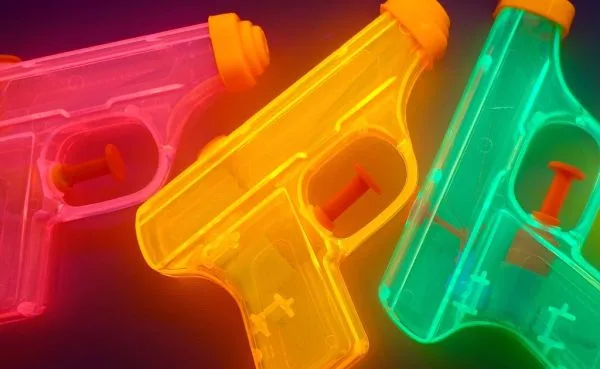
One moulded body, one plunger, no reservoir worth the name. You fill it, you empty it in four seconds, you fill it again.
It is the only class in the range that is essentially a single part, and that one fact drives everything else about it. Nothing to assemble means nothing to go wrong and nothing to slow the line — set for simple squirt guns, our floor sustains around 800,000 units a month. It is the cheapest thing we make and the cheapest to land on a shelf.
Nobody builds a range around it. Plenty of ranges do not work without it. It goes out on clip strips and in multipacks at pocket-money prices, and it is usually the volume that pays for the hero product three shelves up.
The water streamer
A piston in a barrel. Draw back, push forward, and the whole charge leaves in one stream. Mechanically it is closer to a syringe than to a gun, and it is the oldest shape in the category — the traditional Indian pichkari is a streamer, and it has not needed redesigning in a very long time.
Two things make it worth stocking. It throws further than a pump gun of comparable size, because the user's own arm is the pump and there is no valve stealing pressure. And there is almost nothing in it to fail: no trigger linkage, no return spring, no seal under repeated load. Ours run from a single barrel up to versions that discharge three or seven streams at once, which is a decoration decision more than a mechanical one.
If your market has a water-play tradition rather than a water-toy aisle, this is usually the class that sells.
The pump-action gun
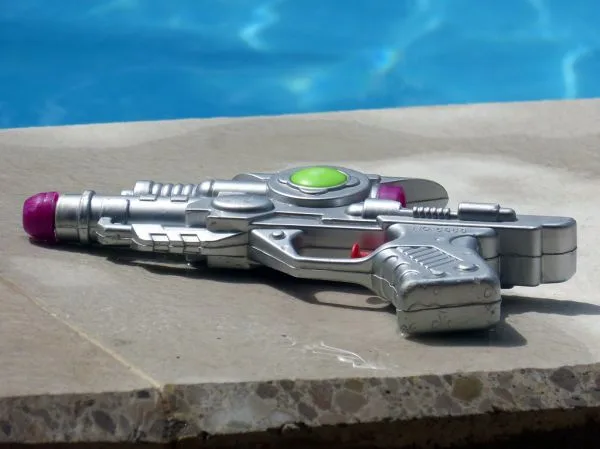
The volume seller, and the class most seasonal toy aisles are built around. One-hand pump, moulded reservoir, trigger, valve.
This is the first product in the list that is a real assembly rather than a moulding. The reservoir is blow-moulded, the mechanism is injection-moulded, and the two have to meet on the same line — which is precisely where a manufacturer either covers both processes or quietly sources half the product from someone else. We run three injection presses and two blow-moulding lines in one shared pool at Faridabad, which is why a gun with a large tank and a fine pump gets made here as one product instead of married up from two suppliers.
Output drops to roughly 400,000 units a month at this class. The drop is the assembly, not the moulding.
The backpack tank
A worn reservoir, a hose, a lance. The top of the range, and the clearest thing we make for showing what both moulding processes do in one product.
Scale changes the engineering here in a way that is easy to underestimate. A large blow-moulded reservoir has to hold pressure and survive being dropped by a child while full. The harness, the hose and the lance are three separate parts with three separate failure modes, and every one of them becomes a line in a toy safety assessment. This is the slowest class we run — between 100,000 and 300,000 units a month — and it is slower at every step rather than blocked at one.
It earns its place anyway. It photographs well, it anchors a range, and it carries the margin the pocket squirt never will.
The electric gun
A motor replaces the arm. Hold the trigger and it runs until the tank is dry.
Taking the work away from the user changes the whole product. Continuous discharge empties a reservoir fast, so an electric design either carries a much bigger tank or accepts a much shorter play cycle — there is no third option. It also introduces four things that exist nowhere else in the range: a motor, a battery compartment, a switch, and a seal between the wet half and the dry half of a toy that will be submerged, dropped, and handed to a six-year-old.
This is the newest class in the category and the one moving fastest. It is also where the gap between a real manufacturer and an anonymous listing shows up soonest, because a motor and a water reservoir sharing a housing is a design problem, not an assembly problem.
Working out which one you want
The order that saves the most time:
Start with the shelf position, not the product — impulse, mid-shelf, or hero. The class usually falls straight out of that answer. Then check it against your price point; if the two disagree, the price point wins. Decoration and pack format come next, and they are cheap to explore because they are changes short of new tooling.
Tooling is last, and most buyers never get there. Our existing range under your own brand needs no new mould and is the fastest route to a shelf. New tooling is the slow, expensive decision, and it should be a deliberate one rather than the default.
Settle compliance before the tooling, not after
Whichever class you pick, a water gun sold as a toy has to meet the toy safety standard of the market it lands in. Ours are manufactured to ASTM F963 for the United States and EN-71 with CE marking for the EU and UK, and certificates are issued against your consignment rather than pulled from an old sample report.
The electric and backpack classes give a compliance assessment more to look at — more parts, more materials, and in the electric case a battery compartment. None of it is difficult. All of it is far easier to settle before tooling runs than after a container is packed. If your market operates its own scheme, or your buyer wants a named test house, say so in the first email.
One note on timing
Water play is not attached to a festival anywhere outside India. It is a summer toy in the northern hemisphere and a year-round one in warm markets, which puts that demand in a quieter part of our production year than the Indian festival peak. For an export buyer that usually shows up as better lead times and more attention on the account.
Garg Global Innovative Limited has manufactured in India since 1951. Water guns are injection- and blow-moulded, assembled, tested and packed at our Faridabad works. Capacities, materials and carton configuration are confirmed against your SKU at quotation.
Request a quote or a spec sheet →
Photographs: "water guns" and "waterguns" by Dean Hochman, and "Toy Water Gun Summer Plastic Wet" by patwilson687, all licensed under CC BY 2.0. Products shown are illustrative and are not GGIL products.
Written by
Ishaan Mehra
Writes about production and export from the Faridabad works.